
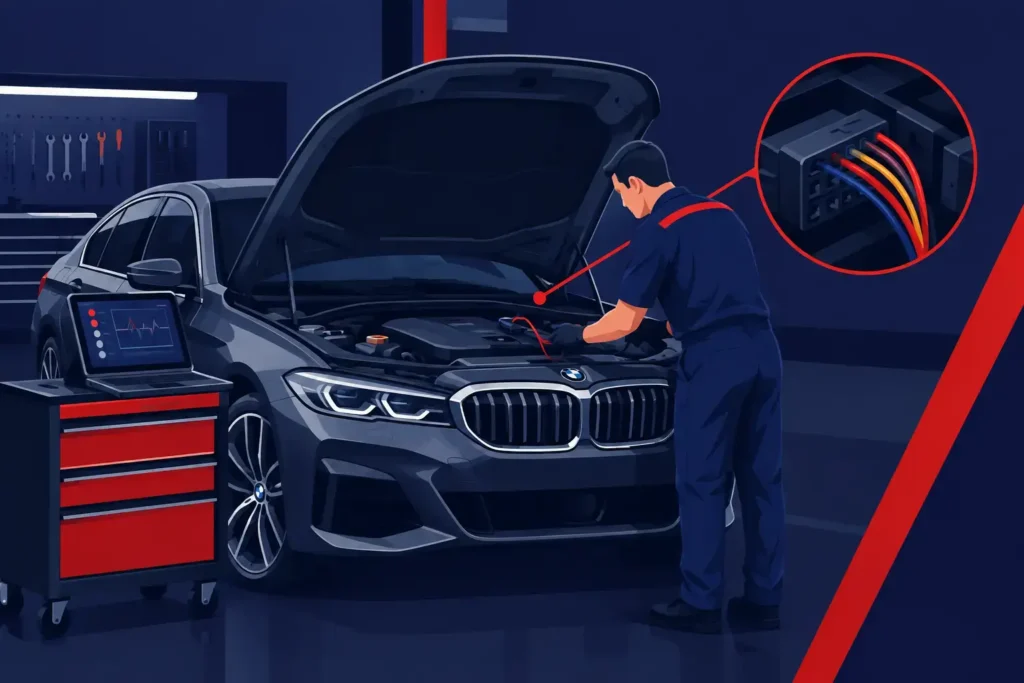
A warning light appears, the screen resets, the transmission shifts strangely, and then everything seems normal on the next drive. That pattern is familiar to owners of BMW, Mercedes-Benz, Audi, Volkswagen, Porsche, and other European vehicles. German car electrical troubleshooting is rarely about guessing at one bad part. It is about finding the source of a voltage, communication, grounding, or component fault before it creates a larger repair.
Modern German vehicles are engineered with tightly connected electronic systems. A weak battery can affect steering, braking, comfort features, engine performance, and transmission operation. A damaged wire in one area can trigger fault codes in several others. Proper diagnosis protects your vehicle from unnecessary parts replacement and gives you a repair plan you can trust.
Why German Electrical Problems Need a Different Approach
German vehicles use advanced control modules that constantly exchange information. The engine computer, transmission control unit, body control module, anti-lock brake system, climate control system, and infotainment system may all communicate over shared networks. When one module loses clean power, a good ground, or network communication, the vehicle can report multiple problems at once.
That does not mean every warning light signals a major failure. Sometimes the cause is as straightforward as an aging battery, corroded battery connection, blown fuse, or faulty sensor. The challenge is that a simple electrical weakness can produce symptoms that look far more serious.
For example, low system voltage can cause harsh or delayed shifting in an automatic transmission because the transmission controller depends on stable voltage and accurate sensor data. Replacing transmission components without confirming battery health, charging output, wiring condition, and stored fault information is not a responsible first step.
Experience matters here. A technician needs to understand how the system is supposed to operate, not just what code appeared on a scan tool.
Common Signs of Electrical Trouble
Electrical faults do not always begin with a no-start condition. More often, owners notice intermittent behavior that gets worse over time. You may see a battery warning light, check engine light, ABS or traction control message, repeated infotainment resets, dim lights, slow cranking, or power accessories that work inconsistently.
Some symptoms deserve prompt attention. A burning odor, hot battery cable, repeated blown fuse, water inside the cabin or trunk, flickering headlights, or a vehicle that loses power while driving should be inspected without delay. Continuing to drive can turn a repairable wiring or charging issue into damage to control modules or other expensive components.
Pay attention to the conditions when the problem occurs. Does it happen only after the car sits overnight? During heavy rain? When the A/C is on? After a recent battery replacement or repair? Those details can help narrow the diagnosis and save time.
German Car Electrical Troubleshooting Starts With the Basics
A quality diagnostic process begins before a technician removes parts. The first step is confirming the customer’s concern and checking the vehicle’s overall electrical foundation.
Battery and charging system testing
Many late-model European cars are sensitive to battery condition. The battery may have enough power to start the engine yet still fall below the voltage needed for every module to operate correctly. Testing should include battery condition, terminal security, cable condition, voltage drop, and alternator output under appropriate load.
Battery replacement can also require registration or programming on certain vehicles. This tells the vehicle’s energy management system that a new battery has been installed and allows it to charge correctly. Skipping this step may shorten battery life or contribute to continuing electrical concerns.
Scan data is a starting point, not a verdict
Professional scan equipment can read manufacturer-specific fault codes, live data, module status, and communication faults. That information is valuable, but a code identifies a system that detected a problem. It does not automatically identify the failed part.
A code for low voltage, sensor circuit malfunction, or lost communication may be caused by a damaged connector, poor ground, water intrusion, failed control module, or wiring issue. Accurate testing verifies power, ground, signal, and network integrity before a repair is recommended.
Visual inspection still matters
The simplest checks can reveal the real problem. Technicians inspect fuses, relays, harness routing, connectors, corrosion, rodent damage, and evidence of previous repairs. On older German and classic vehicles, aged insulation, brittle connectors, and aftermarket wiring deserve special attention. On newer models, moisture intrusion around drains, trunk electronics, door modules, and underhood wiring can be a hidden cause of repeated faults.
The Problems That Are Easy to Misdiagnose
Electrical issues often overlap with mechanical symptoms. A vehicle that will not start might have a weak battery, failing starter, ignition switch problem, crankshaft sensor issue, security-system fault, or poor ground. Each possibility needs testing in the correct order.
Likewise, a transmission warning message does not always mean the transmission needs replacement. The transmission itself may need service or repair, especially when there are internal fault codes, slipping, harsh engagement, or contaminated fluid. But a professional diagnosis should first rule out voltage concerns, connector damage, external sensor faults, and communication problems that can imitate a major transmission failure.
A/C concerns can also involve electronics. If the blower works only on certain speeds, the climate display goes dark, or the compressor does not engage, the issue may involve a control panel, pressure sensor, relay, wiring, or module input. Refrigerant service alone will not correct an electrical fault.
The trade-off is simple: testing takes more care than replacing the most likely part, but it is usually the more cost-effective path. Honest diagnosis reduces repeat visits and helps avoid paying for components your vehicle did not need.
When a DIY Check Makes Sense
Owners can safely look for obvious concerns before scheduling service. Check whether battery terminals are visibly loose or corroded, confirm that interior lights were not left on, and note any warning messages exactly as they appear. If a fuse is blown, do not keep replacing it without finding out why it failed. A fuse is designed to protect the circuit, and repeated failure points to an overload or short circuit.
Avoid probing unfamiliar wiring, bypassing fuses, or installing a larger fuse. Modern German cars contain sensitive modules, airbag circuits, high-current systems, and, on hybrid or electric models, high-voltage components. Improvised repairs can create safety risks and make the original problem harder to trace.
If the vehicle starts and drives normally after a warning appears, do not assume the issue disappeared. Intermittent faults leave clues in stored data, and early testing can prevent a roadside breakdown later.
What Professional Diagnosis Should Give You
A proper electrical inspection should produce more than a list of codes. You should receive a clear explanation of the concern, the testing performed, the confirmed cause when possible, and the repair options. If additional diagnosis is needed, the reason should be explained before work continues.
At MotorSport Prime, the goal is to treat the vehicle as a complete system. With 38 years of hands-on experience working with European, exotic, classic, and everyday vehicles, the focus is on accurate testing, fair recommendations, and repairs that support long-term reliability.
For some concerns, the answer may be a battery service, wiring repair, sensor replacement, or software-related correction. For others, a deeper module, charging-system, or transmission diagnosis may be appropriate. The right repair depends on the test results, the vehicle’s condition, and how you use it.
A German vehicle gives plenty of warning when its electrical system is not happy. Bring in the details you have noticed, ask questions, and insist on testing before parts are replaced. That approach gives your car the best chance to deliver the performance and dependability you bought it for.