
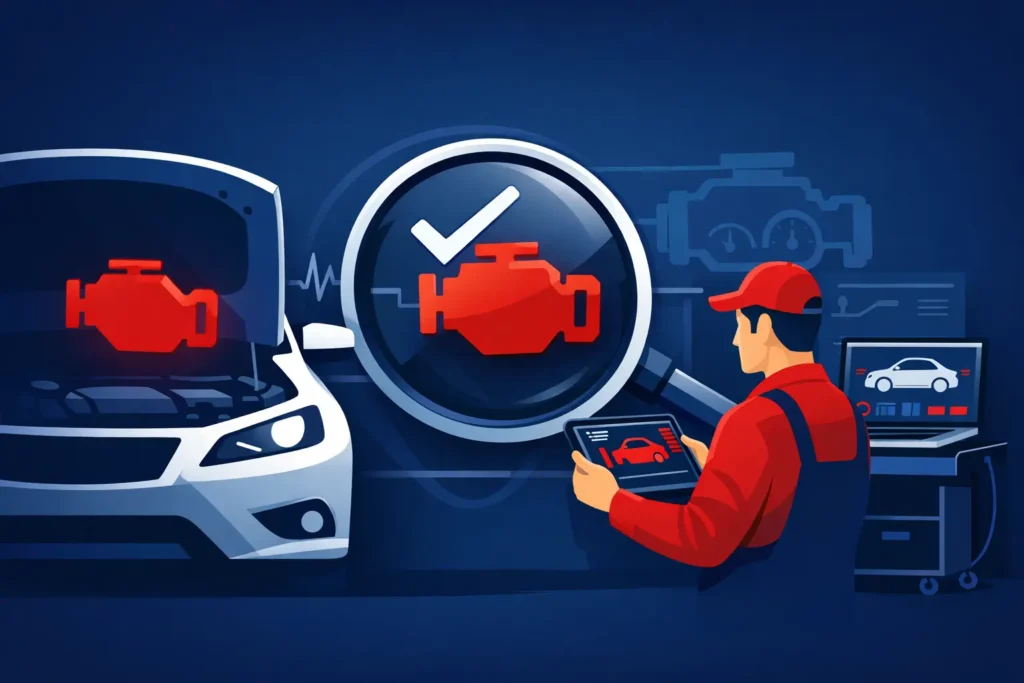
That small amber light on the dash has a way of changing the whole drive. One minute the car feels normal, and the next you are wondering whether you should head home, pull over, or hope it goes away on its own. Good check engine light diagnosis starts with one simple truth – the light is not the problem. It is the car’s way of telling you that a system is out of range, a sensor has picked up something unusual, or a fault has been stored that needs real testing.
Some warning lights point to a minor issue. Others are the first sign of a repair that can become far more expensive if it is ignored. The key is not guessing. The key is finding out why the light came on, what system is involved, and whether the problem affects safety, drivability, fuel economy, emissions, or long-term reliability.
What the check engine light is actually telling you
The check engine light is tied to your vehicle’s onboard diagnostics system. Modern vehicles monitor engine performance, fuel delivery, ignition, emissions equipment, transmission behavior, and many supporting electrical inputs. When the computer sees a reading or operating condition outside the expected range, it stores a diagnostic trouble code and may switch the light on.
That does not always mean a major engine failure is underway. It means the computer has identified a fault or pattern that deserves attention. Sometimes the issue is as simple as an evaporative emissions leak caused by a loose gas cap. Sometimes it is a failing ignition coil, a bad oxygen sensor, a vacuum leak, or a transmission-related signal that affects how the engine and gearbox work together.
This is where experience matters. A stored code points you toward a system. It does not automatically tell you which part should be replaced.
Why check engine light diagnosis is more than reading a code
One of the biggest misunderstandings we see is the idea that scanning codes equals diagnosing the car. It does not. A code reader can tell you what the computer noticed, but not always why it noticed it.
For example, a lean condition code might be caused by a vacuum leak, weak fuel delivery, a faulty mass airflow sensor, or even an exhaust leak affecting sensor readings. A misfire code might come from spark plugs, coils, injectors, compression problems, or internal engine wear. Transmission-related fault codes can also trigger drivability complaints that feel like an engine issue when the root cause is somewhere else.
Proper diagnosis means verifying the complaint, reviewing data, checking freeze-frame information, inspecting related components, and testing the system instead of throwing parts at the car. That approach saves money in the long run because it targets the cause, not just the symptom.
The difference between a steady light and a flashing light
A steady check engine light usually means the vehicle has detected a fault that should be addressed soon, but the car may still be drivable. That said, drivable does not mean harmless. Even a vehicle that seems to run fine can be damaging a catalytic converter, wasting fuel, or causing additional wear.
A flashing check engine light is more urgent. In many cases, that points to an active misfire severe enough to risk catalytic converter damage. If the light is flashing and the engine is running rough, do not keep driving it unless absolutely necessary. Continuing to operate the vehicle can turn a manageable repair into a much more expensive one.
Common causes behind the warning light
There is no single answer because the check engine light can come on for dozens of reasons. Still, a few patterns show up often.
Ignition issues are common. Worn spark plugs, failing coils, and misfires can trigger the light quickly, especially on higher-mileage vehicles or engines with known ignition sensitivities. Fuel system problems are another frequent cause, including weak fuel pumps, clogged injectors, or pressure issues that affect combustion.
Air and vacuum problems also show up often. A cracked intake hose, vacuum leak, dirty throttle body, or failing mass airflow sensor can upset the air-fuel balance enough to set codes. Emissions faults are another big category, including oxygen sensors, catalytic converter efficiency problems, and EVAP leaks.
On some vehicles, especially European models and more advanced drivetrains, the fault may involve communication between modules, sensor plausibility issues, or system interactions that a basic scan tool will not interpret correctly. That is why specialty knowledge can make a real difference.
Why European, exotic, and classic vehicles need a careful approach
Not every vehicle responds to diagnosis the same way. European and exotic vehicles often have more complex module networks, more model-specific failure patterns, and tighter tolerances in how systems are monitored. A fault that looks simple on paper can require manufacturer-level scan data, guided testing, or familiarity with the way a particular platform behaves.
Classic vehicles present a different challenge. Some later classics have early electronic systems that do not behave like modern vehicles, while modified classics may have custom engine management setups, updated transmissions, or mixed components that require a technician to think beyond generic procedures.
In both cases, guessing gets expensive fast. Owners of specialty vehicles usually are not looking for the cheapest answer. They want the correct answer, clear communication, and repairs performed to a standard that protects the car.
What happens during professional check engine light diagnosis
A proper diagnostic process should feel organized and transparent, not mysterious. First, the technician confirms the concern and checks for stored, pending, and history codes. Then the scan data is reviewed to see what the vehicle was doing when the code set. That may include engine load, temperature, RPM, fuel trim, transmission behavior, or sensor values at the moment the fault occurred.
From there, the vehicle may need visual inspection, smoke testing, electrical testing, fuel pressure testing, waveform analysis, or road testing. If the code points toward a transmission input or drivability issue, the testing should include how the engine and transmission are interacting, not just one system in isolation.
At a shop like MotorSport Prime, the goal is simple: identify the root issue honestly, explain what is confirmed versus what is suspected, and recommend the repair that makes sense for the vehicle and the customer. That matters whether the answer is a straightforward sensor replacement or a more involved repair plan.
When it is okay to drive, and when it is not
This depends on how the car is behaving. If the light is steady, the vehicle runs normally, and there are no signs of overheating, stalling, heavy smoke, or severe lack of power, you may be able to drive it a short distance to have it inspected. Even then, delaying too long is risky because some faults quietly damage other components.
If the light is flashing, the engine is shaking, the transmission is shifting erratically, fuel economy drops suddenly, or the car feels unsafe, it should be checked right away. The same goes for any burning smell, loud mechanical noise, or warning signs appearing alongside the check engine light.
A lot depends on the underlying fault. A minor EVAP leak and an active misfire are two very different situations, even though both can trigger the same warning light.
The cost of waiting too long
Drivers often put off diagnostic work because they are worried about what they might hear. That is understandable. But in many cases, waiting is what turns a smaller repair into a major one.
A misfire ignored for too long can damage a catalytic converter. A lean-running engine can cause drivability problems and increased heat. Sensor faults can reduce efficiency and hide bigger performance issues. Transmission-related codes, if overlooked, can allow wear to continue until a serviceable issue becomes a rebuild-level problem.
The smartest move is not panic and it is not denial. It is timely diagnosis.
What honest service should look like
If you bring a vehicle in for a check engine light concern, you deserve more than a printout with a code number and a sales pitch. You should get a real explanation in plain language. What system set the fault? What testing has been done? What has been confirmed? What repair is recommended now, and are there other issues to keep an eye on?
That kind of communication builds trust because it respects the customer. It also leads to better repair decisions. Sometimes the right answer is urgent repair. Sometimes it is scheduling service before the issue worsens. Sometimes it is acknowledging that more diagnostic time is needed before any part should be replaced.
For drivers who plan to keep their vehicles for the long haul, especially those with European, exotic, classic, or transmission-sensitive platforms, that honesty matters as much as technical skill.
A check engine light does not always mean disaster, but it always means your car is asking for attention. The best time to listen is before a warning becomes a breakdown.