
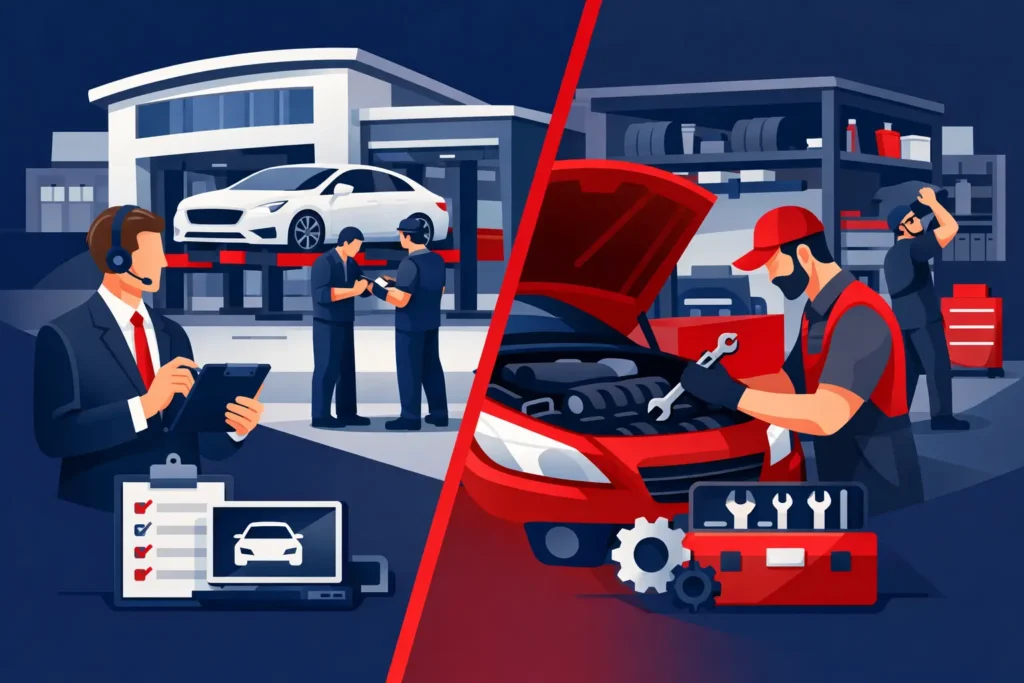
A dashboard warning light, rough shift, or A/C system that suddenly stops cooling creates the same immediate question for many Central Florida drivers: should you go back to the dealer or call an independent shop? The dealer service vs independent mechanic decision is not simply about choosing the cheapest oil change. It is about finding the right level of expertise, equipment, communication, and value for the vehicle you own and the repair it needs.
For a late-model European luxury vehicle, an exotic car, a classic, or a daily driver with a transmission concern, the right answer depends on the job. A good decision starts with understanding what each type of repair facility does well – and what questions to ask before authorizing work.
Dealer Service vs Independent Mechanic: The Real Difference
Dealership service departments are built around a specific manufacturer. Their technicians receive factory training, their diagnostic platforms are closely tied to the brand, and they have direct access to factory service information, recalls, and technical updates. For warranty repairs, safety recalls, software campaigns, and highly specific factory procedures, that relationship can be valuable.
Independent repair shops take a different approach. A qualified independent shop earns its reputation through hands-on diagnostic ability, broad vehicle knowledge, and a more personal relationship with the owner. The best independents invest in advanced scan tools, reliable service information, quality parts, and continuing technician education. They are not limited to one badge on the hood, which can be especially useful for families with multiple vehicles or enthusiasts who own a mix of European, classic, and performance cars.
Neither option is automatically better in every situation. The difference comes down to the repair, the vehicle, and the quality of the specific shop or dealer you are considering.
When the Dealer May Be the Better Choice
A dealer is often the logical first stop when your vehicle is still under the manufacturer’s warranty. If a component failure is covered, the dealer can confirm coverage and complete the repair using factory procedures and original equipment parts. Recall work and manufacturer-issued software updates also generally belong at the dealership.
Some newer vehicles require programming, calibration, or module replacement that is closely controlled by the manufacturer. A dealer may have the most direct access to that process. This does not mean an independent shop cannot handle advanced electronics – many can – but it is reasonable to ask whether the shop has the equipment and access needed for your exact model.
Dealers can also be useful when a manufacturer is considering goodwill assistance for a problem just outside warranty coverage. Those decisions are never guaranteed, but an established dealer service history may help support the conversation.
Where an Independent Shop Can Deliver More Value
Outside of warranty and recall work, an experienced independent mechanic can often provide exceptional service at a more reasonable cost. Dealer overhead is typically higher. Large facilities, manufacturer programs, and dealership operations can affect labor rates and parts pricing. An independent shop may have more flexibility while still using quality original equipment or equivalent parts.
The larger advantage is often the diagnostic process. A skilled technician does not replace parts based solely on a fault code. They test, inspect, verify, and explain the cause of the problem. That matters when a warning light may be caused by a wiring issue, vacuum leak, failing sensor, software concern, or mechanical fault rather than the first part named by a scan tool.
For owners of older European vehicles, classics, and specialty cars, an independent shop with real platform experience can be particularly valuable. These vehicles need technicians who understand their patterns, service history, known weak points, and the difference between a necessary repair and an unnecessary sales recommendation. Experience saves time, avoids guesswork, and helps protect the vehicle’s long-term reliability.
At MotorSport Prime, that approach is central to the work: careful diagnostics, straight answers, and repairs performed to a high standard by technicians with decades of hands-on experience.
Transmission Repairs Require More Than a Quick Opinion
Automatic transmission work is one area where shop selection deserves extra attention. A shift concern could involve fluid condition, internal wear, a valve body issue, a solenoid, an electrical fault, a driveline problem, or an engine performance issue affecting how the transmission behaves. Replacing a transmission before identifying the actual cause can be an expensive mistake.
Ask any shop how it diagnoses transmission complaints. A professional answer should include more than plugging in a scanner. Proper evaluation may involve a road test, fault-code analysis, fluid inspection, service history review, electrical testing, pressure checks, and an assessment of the entire system. Depending on the result, the right repair could be maintenance, a targeted repair, a rebuild, or a complete replacement.
A dealer can be a sound choice for a warranty-related transmission concern. For out-of-warranty repairs, a transmission-focused independent shop may offer more repair options and deeper experience with rebuilding or replacing units when that is truly needed.
Cost Is Important, but Compare the Entire Estimate
A lower estimate is not always a better repair, and a higher estimate is not always evidence of better work. Compare what each estimate includes. Is the shop replacing only the failed part, or addressing related components that commonly cause repeat failures? Are fluids, filters, seals, programming, calibrations, and shop supplies included? What brand of parts will be used?
It is also fair to ask about the warranty on parts and labor. A clear warranty demonstrates confidence, but its terms matter. Find out how long it lasts, what it covers, and whether there are maintenance requirements. For major work such as a transmission replacement, the shop should be comfortable discussing the warranty before repairs begin.
Be cautious with vague estimates and pressure to authorize work immediately. A trustworthy shop can explain the diagnosis in plain language, distinguish urgent safety concerns from maintenance that can wait, and provide a realistic picture of cost. You should understand what is wrong, why the recommended repair is appropriate, and what could happen if you postpone it.
Questions That Help You Choose the Right Shop
Before scheduling service, have a brief conversation with the shop. You do not need to be a technician to ask smart questions. Ask whether they regularly service your make and model, especially if you drive a European, exotic, or classic vehicle. Ask how they approach diagnostic concerns, what parts they use, and whether they can perform required programming or calibrations.
For a significant repair, ask for the findings behind the recommendation. A professional shop should be able to show you relevant fault codes, worn components, fluid condition, photos, or test results when appropriate. They should also tell you if there are multiple repair paths, such as repairing a specific transmission component versus replacing the complete assembly.
Pay attention to how the answers are delivered. Technical language is sometimes necessary, but it should not be used to rush or confuse you. Good service feels respectful. The advisor or technician should listen to your symptoms, ask useful questions about when they occur, and give you room to make an informed decision.
Protecting Your Vehicle Between Visits
The best repair decision is easier when maintenance has not been neglected. Follow the maintenance schedule appropriate for your vehicle and driving conditions, but do not assume every fluid is truly “lifetime.” Heat, traffic, towing, spirited driving, and Florida temperatures all place added stress on engine oil, cooling systems, air conditioning components, and transmission fluid.
Keep records of maintenance and repairs, particularly for specialty vehicles. Records help technicians diagnose recurring concerns and support the vehicle’s resale value. If you notice delayed shifts, slipping, unusual noises, fluid leaks, overheating, a new warning light, or reduced A/C performance, address it early. Small problems often become larger ones when a vehicle is driven until it cannot be ignored.
The best choice is the facility that has the right capability for the work, communicates honestly, and treats your vehicle as something worth preserving. Whether that means dealer service for factory warranty work or an experienced independent mechanic for ongoing care, choose the team that earns your confidence one repair at a time.