
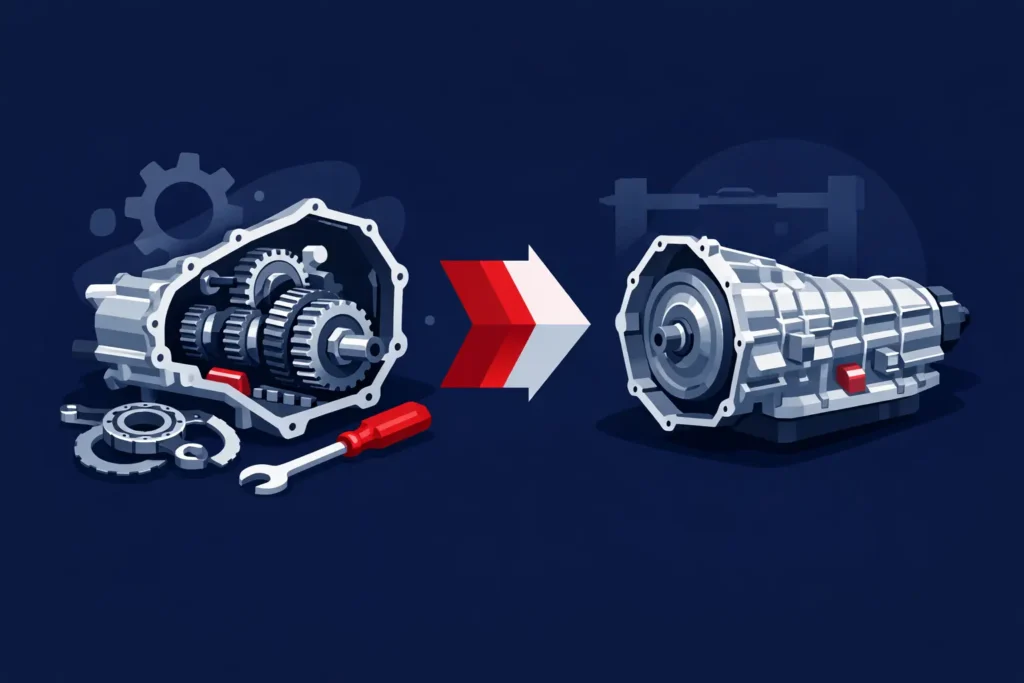
A slipping transmission usually does not fail all at once. It starts with a hard shift leaving a light, a delay going into reverse, or a shudder that was not there last month. When drivers start weighing transmission rebuild vs replacement, they are usually trying to answer one real question: what is the smartest way to fix the car without wasting money or cutting corners?
The honest answer is that there is no universal winner. The right choice depends on what failed, how badly the unit is damaged, the age and value of the vehicle, and how long you plan to keep it. For some cars, a rebuild is the better investment. For others, replacement saves time, risk, and repeat problems.
Transmission rebuild vs replacement: what is the difference?
A transmission rebuild means your existing transmission is removed, disassembled, inspected, cleaned, and repaired with new parts where needed. Worn clutches, seals, gaskets, bands, solenoids, and hard parts are replaced based on condition and failure point. The case and many major components may be reused if they are still within spec.
A replacement means the entire transmission assembly is swapped out for another unit. That replacement could be new, remanufactured, rebuilt elsewhere, or used, depending on the repair plan and the vehicle. The biggest difference is simple: a rebuild restores your original transmission from the inside out, while a replacement installs another complete unit.
That distinction matters more than most people realize. On a European, exotic, or classic vehicle, the original unit may be worth saving if the core components are solid. On a daily driver with catastrophic internal damage, sourcing a quality replacement may make more sense.
When a rebuild makes sense
A rebuild is often the right path when the transmission has a specific internal failure, but the main case and critical hard parts are still usable. If the issue is caught early, a rebuild can restore function without the added cost or uncertainty of replacing the full assembly.
This option is especially valuable when the transmission is difficult to source, tied to a specialty platform, or part of a vehicle you want to preserve long term. Owners of European and classic vehicles often prefer rebuilding because it keeps the car closer to original and allows a skilled technician to address known wear areas directly.
A rebuild can also make sense when diagnosis is clear. If testing shows clutch wear, valve body problems, leaking seals, or failed internal components without widespread destruction, rebuilding gives you a more targeted repair. In the right hands, that can be a very smart investment.
Still, rebuilds are not automatically cheaper or better. If metal debris has moved through the entire unit, the torque converter is contaminated, or key hard parts are cracked or heavily worn, rebuilding may become less practical.
The advantage of rebuilding your original unit
One major benefit of a rebuild is control. The transmission is opened, inspected, and repaired based on what your specific unit needs. That matters because not every transmission fails the same way, and not every vehicle owner has the same goals.
A careful rebuild also gives the shop the chance to inspect related systems, flush contamination, and correct the conditions that led to failure in the first place. That includes fluid quality, cooling issues, electrical faults, and drivability concerns that can damage a transmission over time.
For drivers who value long-term reliability, that level of detail can be worth more than simply swapping parts.
When replacement is the better call
Replacement is often the better option when the transmission has suffered major internal damage. If the case is damaged, the planetary gear set failed, hard parts are no longer serviceable, or there is extensive contamination throughout the system, rebuilding may not be the most efficient path.
Replacement can also be the practical answer when downtime matters. In some cases, a quality remanufactured or properly rebuilt replacement unit can get the vehicle back on the road faster than rebuilding the original from scratch.
For certain late-model vehicles, replacement also makes sense because the repair process is less predictable. Some units have failure patterns that make rebuilding less cost-effective, especially if parts availability is limited or if multiple electronic and hydraulic systems have been compromised.
That said, not all replacement transmissions are equal. A used unit from a salvage source may cost less upfront, but it can carry unknown wear, questionable maintenance history, and no guarantee of long service life. A remanufactured or professionally rebuilt replacement is usually the stronger choice if you want confidence in the repair.
Cost is important, but it is not the whole story
Most people begin with price, and that is fair. Transmission work is a serious repair. But the cheapest estimate is not always the lowest real cost.
With transmission rebuild vs replacement, the better financial decision depends on what you are paying for. A rebuild may cost less if the damage is limited and the unit is worth saving. A replacement may offer better value if rebuilding would require extensive hard-part replacement, more labor, and a higher chance of hidden damage showing up once the unit is opened.
You also need to consider what happens after the invoice is paid. A lower-cost repair that does not address the root cause can end up costing more if the transmission fails again. A proper diagnosis, quality parts, and experienced workmanship matter more than a quick number over the phone.
Financing can also change the decision for some owners. If a more complete repair gives you better long-term reliability and fits the budget with payment options, that may be the smarter move than choosing the least expensive repair today.
Vehicle type changes the answer
This is where experience really matters. The right repair for a domestic commuter car may not be the right repair for a European performance sedan, a classic cruiser, or an exotic weekend car.
Specialty vehicles often have tighter parts availability, more complex programming needs, and higher sensitivity to fluid specification, adaptation procedures, and internal tolerances. In those cases, a generic one-size-fits-all recommendation is risky. The repair has to match the platform.
At MotorSport Prime, that is a big part of the work. After 38 years in the field, the difference between a routine transmission issue and a platform-specific failure pattern is not guesswork. It is the kind of judgment that helps owners avoid unnecessary spending and choose the fix that fits the car.
Diagnosis should come before any recommendation
No honest shop should promise rebuild or replacement before proper testing. Symptoms can point in one direction while the actual fault turns out to be something else. Poor shifting may be caused by internal wear, but it can also come from control issues, fluid problems, cooling concerns, or related drivability faults.
That is why inspection matters. Road testing, scan data, fluid condition, pan inspection, hydraulic evaluation, and electronic diagnosis help determine whether the transmission is failing mechanically or if another issue is contributing to the problem.
This step protects the customer. It also protects the repair. A transmission is only as reliable as the diagnosis behind it.
How to decide what is right for your car
If you are facing transmission rebuild vs replacement, ask a few practical questions. Is the vehicle worth keeping for several more years? Is the transmission original and valuable to preserve? Is the damage limited, or has the failure spread through the entire unit? Are quality replacement options actually available for your platform?
Then ask the shop to explain the reasoning, not just the price. A trustworthy technician should be able to tell you what failed, what they found, what the risks are, and why one path makes more sense than the other. That kind of transparency is a strong sign you are in the right place.
There are times when rebuilding is the best way to protect the value and character of the vehicle. There are other times when replacement is cleaner, faster, and more dependable. Neither choice is automatically right just because it sounds more complete or costs more.
What matters is getting a repair plan built around the actual condition of the transmission, the needs of the vehicle, and the goals of the owner. If your car is showing signs of transmission trouble, the best next step is not to guess. It is to have it diagnosed by people who know the difference between selling a repair and standing behind one.