
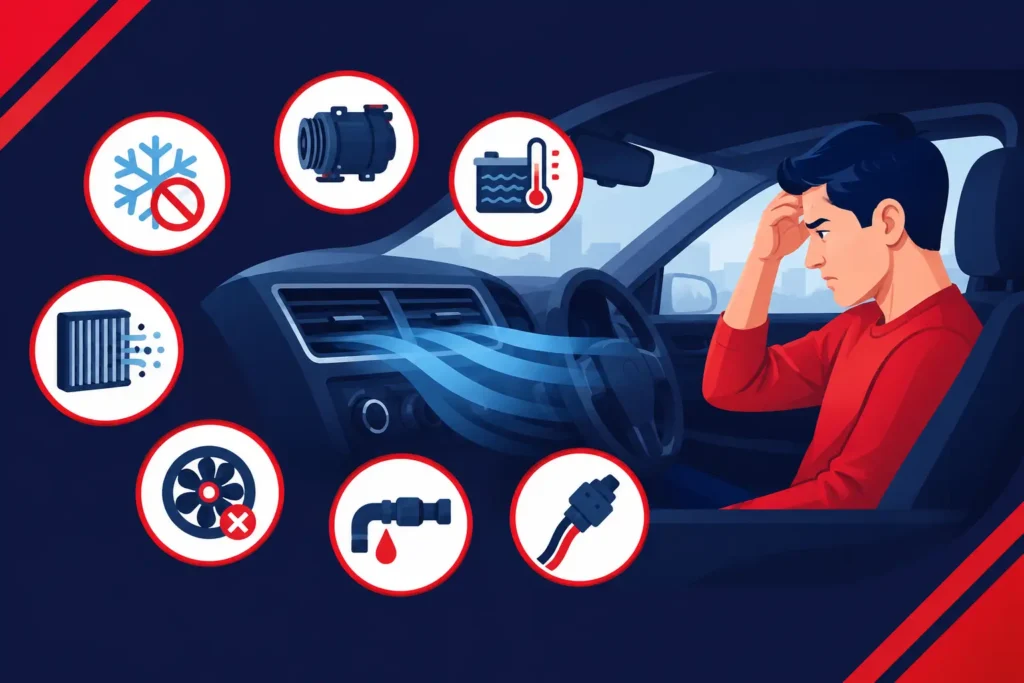
A Central Florida afternoon can expose an A/C problem fast. When the vents are blowing warm air while the cabin keeps heating up, the best reasons for car AC not cooling are usually found in a few connected systems – refrigerant, airflow, electrical controls, and the compressor itself. The right repair starts with determining which system has failed, not simply adding refrigerant and hoping for colder air.
Modern vehicles, especially European luxury models and performance cars, use precise A/C controls and sensors. A symptom that seems simple can have more than one cause. That is why a careful inspection protects both your comfort and your vehicle from an unnecessary repair.
Best Reasons for Car AC Not Cooling
1. Low refrigerant from a leak
Refrigerant carries heat out of the cabin. If the system is low, the A/C may still feel slightly cool while driving but turn warm at a stoplight, or it may stop cooling altogether. Refrigerant does not get used up under normal conditions. A low charge generally means there is a leak somewhere in the sealed system.
Common leak points include service ports, O-rings, hoses, the condenser at the front of the vehicle, and the evaporator behind the dashboard. Road debris and age can damage components, while Florida heat places extra demand on seals and hoses. On a classic car, older hose material and fittings can be part of the issue. On newer vehicles, a small leak may trigger pressure-related system protection before the driver notices a major change.
A proper A/C service includes leak testing before recharging the system. Adding refrigerant without finding the leak can provide temporary relief, but it does not correct the reason the charge became low.
2. A weak or failed compressor
The compressor is the heart of the A/C system. It pressurizes refrigerant so the system can move heat from inside the vehicle to the outside air. When it fails, the vents may blow completely warm, cool only intermittently, or lose cooling as engine speed changes.
Some compressors use a clutch that engages and disengages. Others, common on modern European vehicles, are variable-displacement units managed electronically. A clutch, internal compressor component, control valve, or command signal can fail. That difference matters because replacing a compressor when the actual problem is electrical is expensive and unnecessary.
If a compressor has suffered internal damage, debris may move through the A/C system. In that situation, a quality repair may require more than a new compressor. The shop may need to flush approved components and replace related parts such as the receiver-drier or expansion valve. The exact scope depends on the vehicle and the type of failure.
3. A damaged condenser or restricted airflow
The condenser sits near the radiator and releases heat from the refrigerant. It needs clean, steady airflow to do its job. Bent fins, bugs, leaves, dirt, or front-end damage can reduce that airflow. A condenser may also leak after being struck by road debris.
This problem often shows up in traffic. The A/C may cool acceptably at highway speed, where air naturally moves through the front of the car, then become weak while idling. That pattern can point to condenser airflow, but it can also indicate a cooling fan problem. Pressure testing and visual inspection help separate one from the other.
4. Cooling fans that are not operating correctly
Electric cooling fans support both the engine cooling system and A/C performance. When the vehicle is stopped, these fans pull air across the condenser. If a fan motor is failing, a relay is faulty, a fuse is blown, or the fan control module has a problem, the A/C can lose its ability to cool at idle.
Do not ignore an A/C concern that occurs alongside rising engine temperature. The two systems can be related, and continued driving may risk overheating. A technician should check fan operation, electrical supply, control commands, and actual system pressures rather than assuming the A/C needs refrigerant.
5. An electrical fault, sensor issue, or control problem
Today’s A/C systems depend on more than mechanical parts. Pressure sensors, ambient temperature sensors, cabin temperature sensors, switches, wiring, fuses, relays, and climate-control modules all affect whether the compressor is allowed to operate.
For example, a vehicle may disable the compressor if it receives a pressure reading outside its safe operating range. That protects expensive components, but it can leave the driver with warm air. On a European vehicle with automatic climate control, diagnostic equipment may reveal fault codes or live data that are not visible during a basic visual inspection.
Electrical diagnosis takes patience. An experienced technician verifies power, ground, commands, readings, and component response before recommending parts. That approach helps avoid replacing a good compressor, fan, or sensor based on guesswork.
6. A clogged cabin air filter or weak blower motor
If the air from the vents feels cold but barely moves, the refrigerant system may be working correctly. The issue could be inside the HVAC air-delivery system. A severely clogged cabin air filter can restrict airflow, particularly during pollen season or after driving in dusty conditions. A weak blower motor, failing resistor, or damaged blower control module can create similar symptoms.
This is one of the more affordable causes of weak cabin cooling, but it should still be diagnosed correctly. Low airflow can also be caused by a stuck air door inside the dash. Replacing the cabin filter alone will not correct a failed blower or air-door actuator.
7. A stuck blend door or faulty actuator
Your climate-control system uses doors inside the dashboard to direct air through the heater core or evaporator. A blend door determines whether the air entering the cabin is heated or cooled. When the door sticks or its actuator fails, the A/C system may produce cold air, yet warm air reaches the vents.
Drivers may notice clicking or tapping behind the dash, uneven temperatures between the driver and passenger sides, or air that stays warm regardless of the temperature setting. Dual-zone climate systems can make this issue more noticeable because one side may cool while the other does not.
Accessing a blend door or actuator ranges from straightforward to labor-intensive depending on the vehicle. The repair should be based on confirmed actuator movement and climate-control operation, not just the presence of warm air.
8. An expansion valve or evaporator problem
The expansion valve meters refrigerant into the evaporator, where heat is absorbed from cabin air. If the valve is restricted, stuck, or malfunctioning, refrigerant flow and A/C pressures can become incorrect. The result may be weak cooling, intermittent cooling, or evaporator icing.
The evaporator itself can also develop a leak. Because it is located behind the dashboard, the source is not always obvious from outside the vehicle. A technician may use an electronic leak detector, ultraviolet dye, pressure readings, and other diagnostic methods to pinpoint the failure. This is another reason a quick recharge is not always the best answer.
9. A system that was incorrectly serviced
Overcharging or undercharging an A/C system can reduce cooling and create abnormal pressures. Using the wrong refrigerant or oil can also cause serious problems. Modern systems require the manufacturer-specified refrigerant type and precise charge amount. Performance-oriented, exotic, and late-model European vehicles leave very little room for shortcuts.
A professional recovery-and-recharge procedure removes the existing refrigerant, measures what was removed, checks for leaks and other faults, then restores the correct charge by weight. This is more reliable than adding refrigerant from a can, especially when the vehicle has an underlying mechanical or electrical issue.
When to Schedule an A/C Inspection
Schedule service promptly if the A/C suddenly goes warm, cycles between cold and warm, cools only while moving, makes unusual noises, produces a musty odor, or performs poorly on one side of the cabin. If cooling fades gradually, do not wait until the hottest part of the year. A small leak or weak fan can become a larger repair when the system is pushed hard every day.
At MotorSport Prime, accurate diagnostics come before recommendations. That means checking pressures, airflow, component operation, and vehicle-specific fault information so you understand what is wrong and why the repair is needed. Whether you drive a daily commuter, a classic, or a European performance vehicle, a properly repaired A/C system makes every Florida mile more comfortable.