
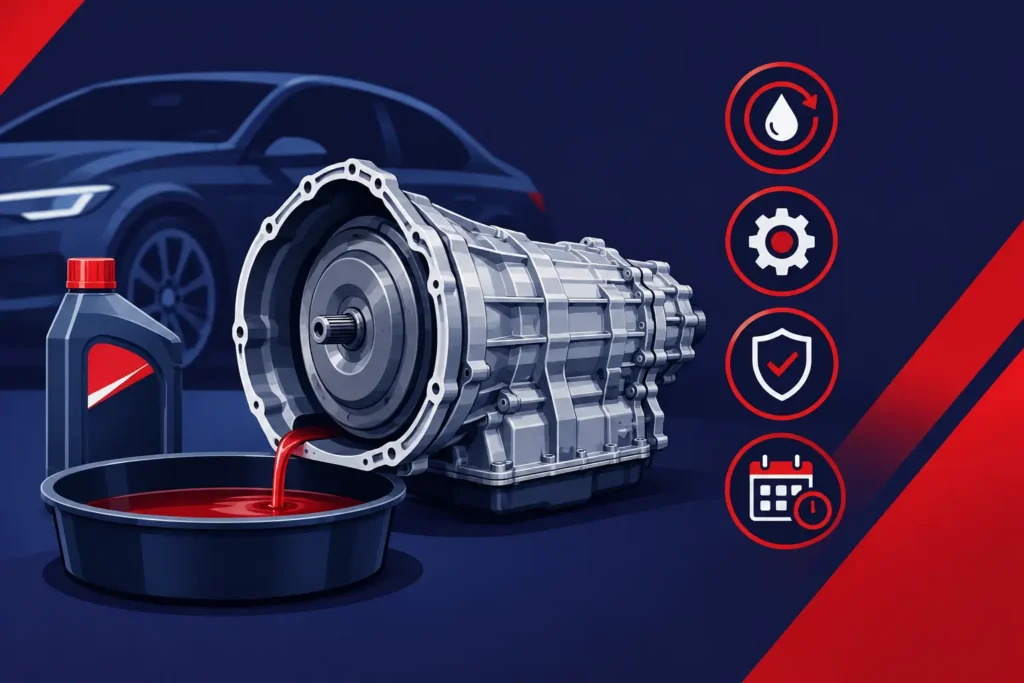
A transmission can feel perfectly normal right up until it does not. One week it shifts cleanly onto the highway; the next, it hesitates leaving a light or bumps into gear. This automatic transmission service intervals guide is designed to help drivers avoid that expensive surprise by understanding when transmission fluid and related service actually deserve attention.
For Central Florida drivers, heat, stop-and-go traffic, sudden rain, and heavy A/C use put real demands on a vehicle. For European, exotic, classic, and everyday vehicles alike, a well-timed transmission service is usually far less costly than repairing damage caused by overheated or degraded fluid.
Automatic Transmission Service Intervals Guide: Start With the Factory Schedule
The owner’s manual is the first authority for your vehicle. Transmission designs, fluid specifications, capacities, and service procedures vary widely. A service interval that is appropriate for a traditional six-speed automatic may be completely wrong for a dual-clutch transmission, a CVT, or a newer nine- or ten-speed unit.
Many manufacturers list transmission service at intervals ranging from roughly 30,000 to 60,000 miles under severe use. Others may recommend 60,000 to 100,000 miles, or give a time-based interval such as every three to five years. Some manuals use terms such as “inspect,” “check,” or “lifetime fluid,” which can create confusion.
“Lifetime” does not always mean the fluid will perform indefinitely under every driving condition. It often reflects the manufacturer’s definition of the vehicle’s expected service life under normal use. Owners who plan to keep a vehicle for many years, tow, drive in high heat, or spend much of their time in traffic should treat that wording with caution and ask for a professional recommendation based on the actual vehicle and its use.
A qualified technician should also verify the exact transmission code. This matters especially on European vehicles, where the same model line may use different transmissions, pans, filters, and fluid requirements from one year or engine configuration to another.
Mileage Is Only Part of the Answer
Transmission fluid does more than lubricate moving parts. It carries heat away from internal components, operates hydraulic circuits, helps control clutch engagement, and protects metal surfaces. As fluid ages, heat and wear can reduce its ability to do those jobs consistently.
A car that covers 50,000 easy highway miles may place less stress on its transmission than one that accumulates 25,000 miles in city traffic. Frequent short trips can also be harder on the system because the vehicle may not always reach stable operating temperature.
Consider earlier service when your vehicle regularly faces four or more of these conditions:
- Stop-and-go commuting or frequent short trips
- High ambient temperatures, which are common across Central Florida
- Towing, hauling, or carrying heavy loads
- Aggressive driving, track use, or repeated hard acceleration
- Mountain driving, off-road use, or prolonged low-speed operation
- Commercial, rideshare, or delivery use
There is no benefit to guessing. The right interval balances prevention with the manufacturer’s requirements and the transmission’s condition. Servicing too late can allow avoidable wear. Servicing with the wrong fluid, incorrect level, or improper procedure can cause problems just as quickly.
Time Matters Even When You Do Not Drive Much
Low-mileage vehicles are often overlooked. A weekend classic, a seasonal vehicle, or a low-use luxury car may not reach its mileage target for years, but fluids still age. Moisture, temperature cycling, seal condition, and long periods of sitting can all affect how a transmission performs.
For vehicles driven only occasionally, a time-based review is sensible. A technician can inspect for leaks, assess fluid condition where accessible, scan for stored transmission faults, and determine whether a fluid service is appropriate. This is especially worthwhile before a long road trip or after purchasing a used vehicle with incomplete maintenance records.
Classic vehicles deserve their own approach. Their transmission designs, original fluid recommendations, and replacement parts may differ substantially from modern vehicles. The goal is not to force a modern interval onto an older car. It is to preserve the transmission with the correct fluid and a service plan that respects its design and condition.
Know What Type of Transmission You Have
“Automatic” is a broad category. Modern vehicles may use a conventional torque-converter automatic, a continuously variable transmission (CVT), an automated manual, or a dual-clutch transmission. Each has different fluid needs.
Conventional automatics commonly use automatic transmission fluid, often called ATF, formulated for a specific manufacturer standard. CVTs require dedicated CVT fluid that supports the belt or chain and pulley system. Dual-clutch transmissions may use specialized fluid for wet clutches and precision hydraulic controls. Installing a universal fluid because it is convenient or inexpensive is not a responsible shortcut.
Some transmissions have serviceable filters inside the pan. Others have cartridge filters, external filters, or no regularly replaceable filter. Some require the fluid level to be set at a precise temperature using scan-tool data. This is why transmission service is not simply a matter of removing a drain plug and refilling what came out.
Drain and Fill vs. Flush: The Right Method Depends
A drain-and-fill service removes a portion of the old fluid, then restores the system with the proper amount of approved fluid. Depending on the vehicle, this may include replacing the filter, pan gasket, sealing sleeve, or pan assembly. It is a common maintenance procedure and can be repeated over time when appropriate.
A fluid exchange or flush may replace more of the old fluid, but it is not automatically the best choice for every transmission. The procedure, equipment, and fluid must be compatible with the manufacturer’s guidance. On a neglected, high-mileage transmission that already slips or shifts poorly, an aggressive service may not solve an existing mechanical problem.
That is where an honest inspection matters. If the fluid is badly burnt, the pan contains excessive metal debris, or diagnostic testing identifies internal faults, the conversation should focus on the condition of the transmission rather than selling a maintenance service as a cure. Good service protects a healthy or serviceable transmission. It cannot rebuild worn clutches, repair a failed valve body, or correct a broken internal component.
Warning Signs That Should Not Wait for the Next Interval
A scheduled service is preventive. Warning signs call for diagnosis. If your vehicle has delayed engagement when shifting into Drive or Reverse, shuddering, slipping, harsh gear changes, flare between shifts, transmission overheating messages, or a check engine light, schedule an inspection soon.
Fluid leaks also deserve attention. Transmission fluid can be red, amber, brown, or even nearly clear depending on the formulation and age, so color alone is not a reliable diagnosis. A technician should identify the source before a low fluid level creates more serious damage.
Do not ignore a new vibration simply because the vehicle still drives. Some issues that feel like a transmission problem may come from an engine misfire, worn mount, axle, wheel bearing, or driveline component. Accurate diagnostics protect you from replacing parts that are not actually at fault.
What a Professional Transmission Service Should Include
A proper service begins before fluid is added. The technician should confirm the vehicle’s transmission type, service history, factory fluid specification, and any current symptoms. A road test and electronic scan can reveal shift behavior, fault codes, temperature concerns, and adaptation issues that may not be obvious during a quick visual inspection.
The service itself should use the correct approved fluid and the correct fill procedure. Where applicable, it should include filter and sealing component replacement, inspection of the old fluid and pan, leak checks, and verification of the final fluid level at the required temperature. The shop should explain what it found in clear terms, including whether the transmission shows normal wear or signs that require additional attention.
At MotorSport Prime, that approach is part of the work. With 38 years of hands-on experience, the focus is on practical answers, accurate diagnosis, and service that supports the long-term reliability of the vehicle rather than unnecessary upselling.
Build a Service Plan Before Problems Start
If your manual provides a clear interval, use it as the foundation. If the vehicle sees severe use, lives in Florida heat, has unknown service history, or is a specialty vehicle with unique requirements, have the interval reviewed by a transmission specialist. Keep records of the mileage, date, fluid used, and parts replaced. That documentation helps protect resale value and gives the next technician useful information.
The best time to ask about transmission service is when the vehicle is shifting normally. A thoughtful maintenance decision made now can help preserve the smooth, confident drive you expect every time you put the car in gear.