
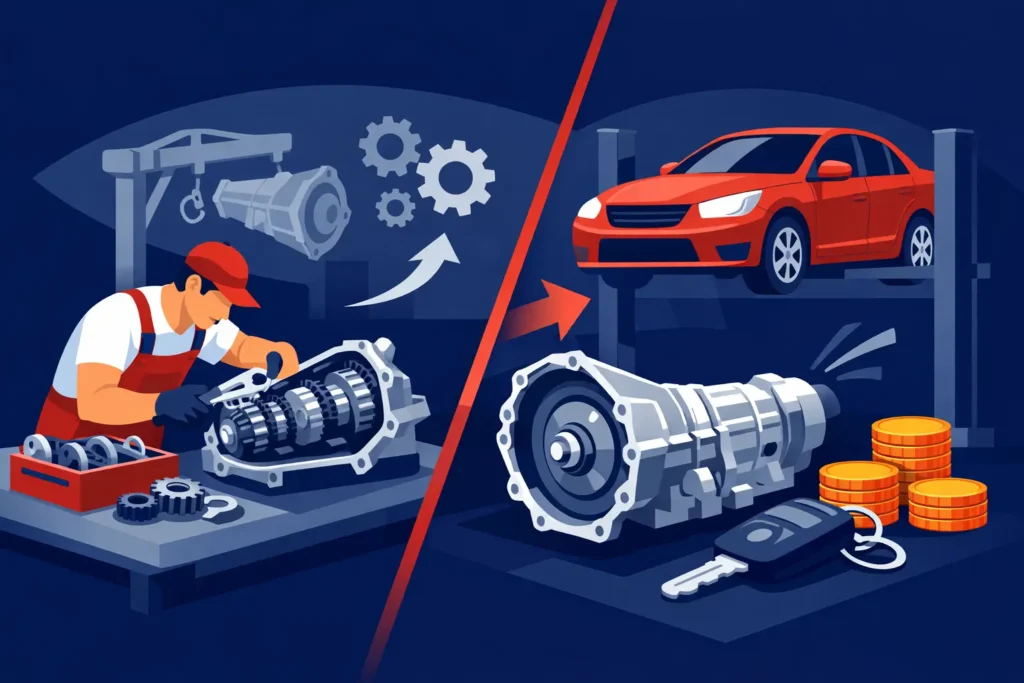
A slipping transmission usually does not leave much room for denial. One day the shifts feel delayed, the RPMs flare, or reverse takes a long pause to engage, and suddenly the question becomes rebuild vs replace transmission. For most drivers, the real concern is simpler: what fixes the problem properly without wasting money or risking another failure a few months later?
That answer depends on the condition of the transmission, the vehicle itself, and how long you plan to keep it. If you drive a European car, an exotic vehicle, a classic, or even a well-kept daily driver, the right choice is rarely based on price alone. It comes down to diagnosis, parts quality, labor standards, and whether the repair matches the value of the vehicle.
Rebuild vs Replace Transmission: The Core Difference
A transmission rebuild means your existing unit is removed, disassembled, inspected, cleaned, and repaired with new or reconditioned components where needed. Worn clutches, seals, bands, bushings, solenoids, and other internal parts may be replaced. Hard parts such as gears, drums, or the valve body are evaluated closely and replaced if damaged.
A transmission replacement means the original unit is removed and another transmission is installed in its place. That replacement might be brand new, remanufactured, rebuilt elsewhere, or used. Those are very different options, and the quality can vary quite a bit.
This is where many vehicle owners get bad advice. “Replace it” sounds simple, but not all replacement transmissions are equal. A used unit may get the car moving again, but it can also come with unknown wear, questionable history, or compatibility issues. A properly rebuilt or remanufactured transmission is a much different standard than a salvage-yard swap.
When a Transmission Rebuild Makes Sense
A rebuild is often the better option when the transmission case is good, the core unit is rebuildable, and the damage is mostly internal wear rather than catastrophic destruction. If the transmission has clutch material breakdown, seal failure, valve body issues, or worn internal components from age and mileage, rebuilding can restore the unit to reliable operating condition.
For specialty vehicles, rebuilding can be especially smart. European, exotic, and classic models do not always have straightforward replacement options. New units can be expensive or difficult to source, and used units may be even riskier if the platform has known weaknesses. Rebuilding the original transmission allows the technician to inspect the exact unit from your car, address the failure directly, and keep the repair aligned with the vehicle.
There is also a value argument. If the rest of the vehicle is in strong condition and you plan to keep it, rebuilding can be a solid long-term investment. You are not just installing another unknown transmission and hoping for the best. You are correcting wear and damage inside the unit you already own.
That said, a rebuild only works when it is done thoroughly. A partial repair that replaces one failed component while leaving other worn parts untouched is not the same thing as a proper rebuild. That shortcut often leads to repeat problems.
When Replacing the Transmission Is the Better Call
Replacement makes more sense when the original transmission is too badly damaged to rebuild economically. If the case is cracked, hard parts are destroyed, metal contamination is extensive, or the internal failure has spread through the entire unit, rebuilding may become less practical.
Sometimes availability also drives the decision. If a high-quality remanufactured unit is available with strong warranty coverage and the price is competitive, replacement may offer better value. This can be true for more common vehicles where sourcing a proven unit is easier.
Replacement may also be the better path if time matters. A rebuild takes inspection, parts sourcing, machining in some cases, and careful assembly. A replacement can move faster when the correct unit is readily available. For a customer who needs the vehicle back on the road quickly, that timing can matter.
Still, replacing the transmission is not automatically the safer choice. It depends on what is being installed. A quality remanufactured transmission is one thing. A used transmission with 90,000 unknown miles is another.
Cost Is Important, but It Is Not the Whole Story
Most people start with cost, and that is fair. Transmission work is a major repair, and no one wants surprises. But the rebuild vs replace transmission decision should be based on total value, not just the first estimate.
A rebuild can cost less than a full replacement in some cases, especially when the original transmission is a good candidate and major hard parts are still usable. In other cases, once internal damage is fully uncovered, the rebuild cost can climb enough that a replacement starts to make more sense.
Replacement pricing also has a wide range. A used transmission may look cheaper upfront, but if it fails early or has installation-related compatibility issues, it quickly becomes the more expensive choice. A remanufactured or premium rebuilt replacement usually costs more than a used unit, but it can offer better reliability and warranty support.
The better question is not “Which is cheaper today?” It is “Which repair gives me the best result for this vehicle?” That is where honest diagnostics matter.
What a Proper Diagnosis Should Tell You
No trustworthy shop should recommend a rebuild or replacement based on symptoms alone. Delayed shifting, slipping, harsh engagement, warning lights, and fluid leaks can point to internal failure, but they can also involve electronics, solenoids, valve body problems, cooling issues, or maintenance neglect.
A proper diagnosis should look at fluid condition, scan data, road test behavior, line pressure where appropriate, external leaks, and the overall health of the transmission system. If there is metal in the pan or severe clutch material contamination, that tells a very different story than a drivability complaint caused by an electrical fault.
This matters because not every transmission problem requires a full rebuild or replacement. Sometimes the right repair is more targeted. Other times, the symptoms are just the beginning of deeper internal wear. Guessing is expensive. Clear testing saves money and frustration.
Vehicle Type Changes the Right Answer
A basic commuter car and a performance-oriented European vehicle should not be evaluated the same way. The transmission in a specialty car is often more sensitive to fluid quality, software behavior, internal tolerances, and replacement part standards. That raises the stakes.
On a classic vehicle, preserving the original transmission may have value beyond simple transportation. On an exotic or European model, a low-quality replacement can create drivability issues that never truly go away. Shift quality, control adaptation, and parts matching all matter more than many owners realize.
That is why experience matters. Shops that work regularly with transmissions and understand specialty vehicles are more likely to spot the difference between a repair that is merely possible and one that is actually right.
Questions Worth Asking Before You Approve Either Option
If a shop recommends a rebuild, ask what failed, what parts will be replaced, and whether hard parts have been inspected. If they recommend replacement, ask what kind of transmission is being installed – new, remanufactured, rebuilt, or used – and what warranty comes with it.
You should also ask whether the cooler system will be cleaned or replaced if contamination is present, whether software updates or relearn procedures are needed, and whether related issues such as mounts, leaks, or torque converter problems are being addressed. A transmission repair is only as good as the complete job around it.
Clear answers are a good sign. Vague answers usually are not.
The Best Choice Is the One That Matches the Car
There is no honest one-size-fits-all answer to rebuild vs replace transmission. A rebuild can be the smarter move when the original unit is worth saving and the work is done to a high standard. Replacement can be the better path when damage is severe, turnaround time matters, or a quality remanufactured unit offers stronger value.
At MotorSport Prime, that decision starts with diagnosis, not sales pressure. After 38 years in the field, we know the right transmission repair is the one that fits the condition of the vehicle, the expectations of the owner, and the standard the job deserves.
If your transmission is starting to slip, hesitate, or shift harder than it should, do not wait for a small problem to become a major failure. The earlier you get clear answers, the more options you usually have – and the better your chances of fixing it once and fixing it right.