
A transmission problem rarely announces itself at a convenient time. Maybe your car hesitates pulling into traffic, revs higher than usual on the highway, or shudders when leaving a stoplight. Understanding CVT versus automatic transmission helps you recognize what your vehicle is designed to do, what normal operation feels like, and when a change in behavior deserves professional attention.
Both designs transfer engine power to the wheels without requiring the driver to shift gears manually. But they do it in very different ways. That difference affects driving feel, fuel economy, service requirements, and the repair decisions you may face over the life of the vehicle.
CVT Versus Automatic Transmission: The Core Difference
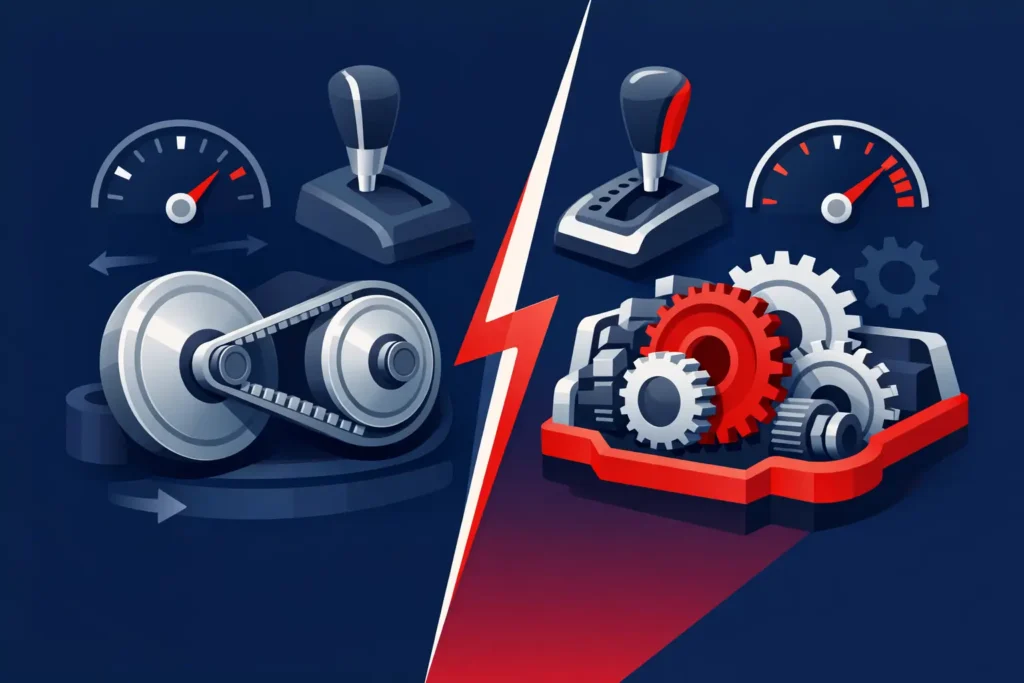
A conventional automatic transmission uses a set number of physical gears. Depending on the vehicle, it may have six, eight, nine, or 10 forward speeds. It shifts between those gears using hydraulic pressure, clutch packs, a torque converter, and electronic controls. Most drivers recognize the brief change in engine speed as the transmission moves from one gear to the next.
A continuously variable transmission, or CVT, does not use fixed gear ratios in the same way. Many belt-driven CVTs use two adjustable pulleys connected by a steel belt or chain. As the pulley diameters change, the transmission creates an almost unlimited range of ratios within its operating limits. The goal is to keep the engine near its most efficient RPM for the situation.
That is why a CVT can feel different under acceleration. Instead of feeling distinct shifts, the engine may rise to a steady RPM while the vehicle continues gaining speed. Some drivers like the smoothness. Others describe it as a droning or disconnected sensation, especially when they expect the familiar shift points of a traditional automatic.
Neither design is automatically better in every vehicle. The right fit depends on how the vehicle is engineered, how it is driven, and how consistently it is maintained.
Driving Feel, Performance, and Fuel Economy
CVTs are common in compact cars, crossovers, and hybrid vehicles because they can improve fuel economy and provide smooth low-speed operation. By continuously adjusting the ratio, the CVT can help the engine work efficiently during routine commuting. For drivers who spend most of their time in Central Florida traffic, that smoothness can be a real advantage.
A traditional automatic is often the preferred choice for drivers who value a more direct, familiar response. The defined gear changes can make acceleration feel more connected and controlled. Many European luxury, performance, and heavier-duty vehicles use sophisticated conventional automatics because they manage higher torque loads well while delivering quick, confident shifts.
Modern automatic transmissions are far more advanced than older four-speed units. Electronic controls can adapt shifting behavior to throttle input, road conditions, driving modes, and even navigation data on certain vehicles. A well-calibrated eight- or 10-speed automatic can be both responsive and efficient.
There are exceptions. Some manufacturers program CVTs with simulated shift points to create a more conventional feel. Some automatics can feel hesitant or hunt between gears when there is a control, fluid, or mechanical issue. The badge on the transmission matters less than whether it is operating as designed.
Maintenance Is Not One-Size-Fits-All
One of the costliest mistakes we see is treating all transmission fluid as interchangeable. It is not. CVTs require specific fluid designed for their belts, pulleys, clutches, hydraulic circuits, and friction characteristics. Installing the wrong fluid, using a universal product without confirming compatibility, or ignoring a service need can create expensive problems.
Conventional automatics also need the correct manufacturer-specified fluid. Their internal clutch packs, valve body, torque converter, seals, and solenoids rely on clean fluid with the correct viscosity and additive package. Fluid does more than lubricate parts. It transfers hydraulic pressure, manages heat, and allows internal clutches to apply correctly.
Service intervals vary by make, model, transmission type, mileage, towing use, heat exposure, and driving habits. A vehicle used for short trips, stop-and-go traffic, performance driving, or towing may need closer attention than one that sees easy highway miles. The owner’s manual provides a starting point, but a proper inspection gives a better picture of the transmission’s current condition.
A professional service may include draining and refilling fluid, replacing a serviceable filter, inspecting for leaks, checking pan debris where applicable, and evaluating the transmission’s operation with diagnostic equipment. A flush is not the answer for every vehicle or every condition. If fluid is severely degraded or a transmission already has internal damage, the correct next step depends on the diagnosis, not a one-size-fits-all sales pitch.
Reliability and Repair Costs
Reliability is shaped by design, maintenance history, operating conditions, and the individual vehicle. A properly maintained CVT can provide many dependable miles. However, because its internal components are precision-built and model-specific, major CVT repairs are often less straightforward than repairs to some conventional automatics. In certain cases, replacement with a quality unit is more practical than rebuilding.
Conventional automatic transmissions have their own failure points, including worn clutch packs, damaged torque converters, valve body faults, failed solenoids, and internal hydraulic pressure loss. The good news is that many traditional automatics have well-established repair paths. Depending on the vehicle and failure, a targeted repair, rebuild, or replacement may be available.
Repair cost should never be judged by the transmission type alone. A simple external leak or electrical fault may be far less costly than internal damage. On the other hand, continued driving with slipping, overheating, or harsh shifting can turn a manageable issue into a complete transmission failure.
For specialty European, exotic, and classic vehicles, accurate diagnosis matters even more. Parts availability, programming requirements, and vehicle-specific procedures can all affect the repair plan. An experienced transmission specialist looks beyond the obvious symptom before recommending work.
Symptoms That Deserve Attention
A healthy CVT should accelerate smoothly without unusual vibration, excessive engine flare, warning lights, or delayed engagement. A healthy automatic should shift predictably and engage drive or reverse without a long pause, harsh bang, or slipping sensation. Any transmission can develop problems, but early symptoms are worth checking before they worsen.
Watch for these warning signs:
- Delayed engagement when shifting into drive or reverse
- Slipping, shuddering, jerking, or an unexplained loss of acceleration
- High RPM without a matching increase in vehicle speed
- Burning smells, visible fluid leaks, or dark and contaminated fluid
- A transmission or check-engine warning light
- New whining, humming, clunking, or grinding noises
A noise or shift concern is not always an internal transmission failure. Engine performance issues, worn mounts, axle problems, low battery voltage, sensor faults, and software concerns can all imitate transmission trouble. That is why a road test, scan data, fluid inspection, and careful system diagnosis should come before a major repair recommendation.
Which Transmission Is Right for You?
If you are shopping for a vehicle, a CVT can be an excellent fit when fuel economy, smooth commuting, and efficient everyday driving are the priority. It is especially common in smaller vehicles and hybrids designed around those goals. The key is following the correct maintenance schedule and paying attention to changes in behavior.
A conventional automatic may suit drivers who want more defined shifts, stronger towing capability, performance-oriented response, or the character expected from many luxury and specialty vehicles. That does not make it maintenance-free. Modern automatics are highly capable, but they depend on proper fluid, accurate diagnostics, and timely service just as much as CVTs do.
For the vehicle already in your driveway, the best choice has been made by its manufacturer. Your job is to protect that system with the right service, not force it into a generic maintenance plan. At MotorSport Prime, that means looking at the vehicle, its history, its symptoms, and its intended use before discussing repair options.
If your transmission feels different from last month, trust that observation. A clear diagnostic answer and honest repair plan can protect your vehicle’s reliability long before a small concern becomes a roadside problem.