
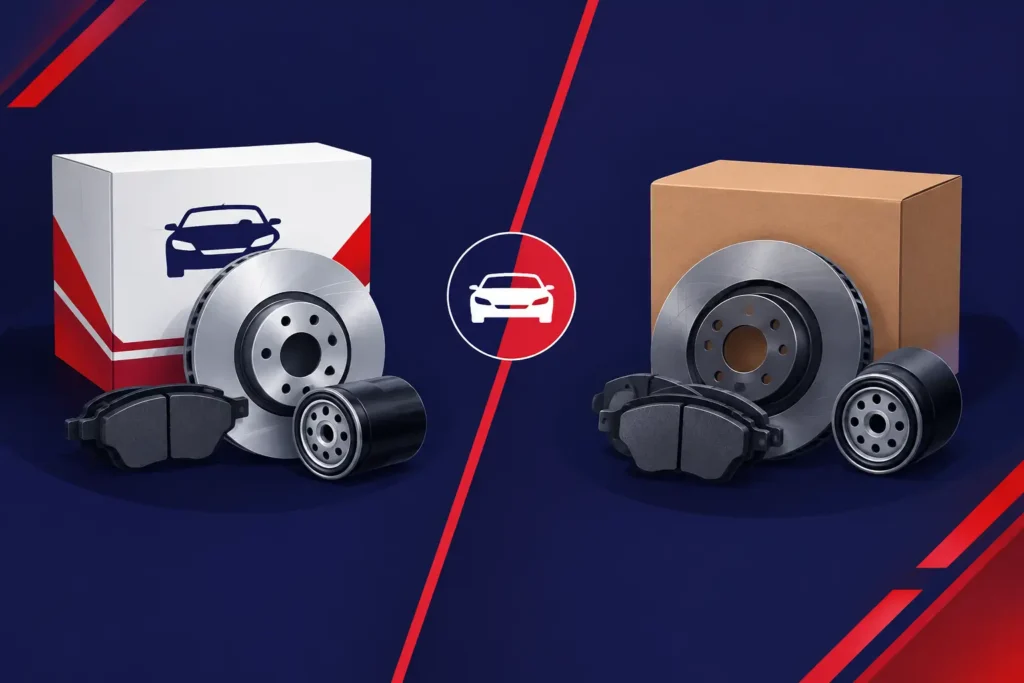
A failed alternator on a daily driver and a worn transmission solenoid in a European luxury car may both need replacement parts, but they do not carry the same risk. That is why the OEM vs aftermarket parts decision should never be reduced to one rule for every vehicle. The right choice depends on the part, the vehicle, how it is used, and what will protect your investment over the long run.
At MotorSport Prime, we believe customers deserve a clear explanation of their options, not pressure toward the most expensive line item or the cheapest available part. Quality repair begins with accurate diagnosis, then choosing components that deliver the fit, performance, and reliability the job requires.
What OEM Parts Really Mean
OEM stands for Original Equipment Manufacturer. In practical terms, an OEM part is made by the vehicle manufacturer or supplied through that manufacturer’s approved parts network. It is designed to match the component originally installed on your vehicle.
OEM parts are often the safest choice when fitment, programming, calibration, or material quality is especially critical. They are built to the automaker’s specifications and are generally backed by a manufacturer warranty. For a newer vehicle, a specialty European model, or a repair involving sensitive electronic systems, that confidence can be worth the additional cost.
There is one detail worth understanding: the company whose name appears on the box may not have physically manufactured every component. Automakers frequently use established suppliers for items such as sensors, brakes, ignition components, and cooling parts. The difference is that an OEM-branded part is supplied through the vehicle manufacturer and meets its specified standards for that application.
What Aftermarket Parts Include
Aftermarket parts are made by companies other than the vehicle manufacturer. This category is broad. It includes respected suppliers that build excellent replacement components, performance-oriented manufacturers, economy brands, and unfortunately, low-quality parts that may look right but do not last.
That range is why “aftermarket” is not automatically a warning sign or a recommendation. A premium aftermarket suspension component, brake rotor, or filter may provide equal or better service than the original part. On the other hand, an inexpensive electronic module with inconsistent quality control can create a frustrating cycle of warning lights, poor drivability, and repeat repairs.
The key is evaluating the specific manufacturer and application. A qualified technician should be able to explain why a particular part is being recommended, whether it carries a meaningful warranty, and what trade-offs come with a lower-cost alternative.
OEM vs Aftermarket Parts: The Real Differences
Price is usually the first difference drivers notice. OEM parts commonly cost more because of manufacturer branding, supply channels, engineering specifications, and warranty support. Aftermarket options can reduce the repair bill, sometimes substantially.
But initial price is only one part of repair value. A part that costs less but fails early, fits poorly, or requires extra labor to replace again is rarely a bargain. This is particularly true when access is difficult. Saving money on a component buried behind the dash, inside an engine bay, or within a transmission service area can lead to a much higher total cost later.
Fit and consistency are another major consideration. OEM parts generally offer predictable fit because they were designed for the vehicle. High-quality aftermarket parts often fit very well, but quality can vary by brand and product line. Minor differences in connector design, sealing surfaces, sensor readings, or mounting points can matter on modern vehicles.
Availability can favor aftermarket parts. For older vehicles, classics, and certain specialty applications, the original part may be discontinued or difficult to source. A reputable aftermarket replacement may be the practical answer. In other cases, an upgraded aftermarket component can solve a known weakness in the original design.
When OEM Is Usually Worth the Cost
OEM is often the stronger recommendation for electronic components that must communicate precisely with the vehicle, including certain sensors, control modules, switches, and actuators. Many late-model European vehicles are especially sensitive to component specifications and software compatibility.
It also makes sense to consider OEM for parts that affect safety, factory fit and finish, or complicated labor. Items such as airbag-related components, specialized cooling system pieces, trim that must align correctly, and certain engine or transmission electronics are not areas where we recommend gambling on an unknown brand.
For transmission repairs, the correct part choice is critical. Solenoids, valve body components, internal seals, filters, electrical connectors, and fluid specifications all influence shift quality and transmission life. A transmission does not respond well to guesswork. Using the wrong fluid or a poorly matched component can cause symptoms that appear unrelated to the original repair.
Owners of exotic, classic, and European vehicles should also consider long-term value. Maintaining the correct quality level can support reliability, driving character, and resale confidence. That does not mean every replacement must come in an automaker box. It means the part should be selected with an understanding of the vehicle, not simply its price tag.
When a Quality Aftermarket Part Makes Sense
A quality aftermarket part can be an excellent choice for many routine repairs. Filters, wiper components, batteries, brake parts, belts, hoses, and some suspension or steering components are often available from trusted manufacturers with proven track records.
Aftermarket can also be the better option when the original design has a documented weakness. An upgraded radiator, ignition component, bushing, or cooling system part may offer improved materials or design changes that help it last longer than the factory version. Performance applications can also call for aftermarket solutions built for increased heat, power, or track use.
For an older daily driver, a reliable aftermarket component may strike the right balance between repair cost and dependable transportation. The goal is not to overspend on a vehicle beyond its needs, but to avoid installing a part that compromises safety or leaves you stranded.
A good repair shop will distinguish between a proven aftermarket brand and a no-name alternative. The label “aftermarket” alone does not tell you enough.
Questions to Ask Before Approving a Repair
You do not need to be a parts expert to make a smart decision. Ask whether the recommended part is OEM, aftermarket, or an original supplier equivalent. Ask why that option fits your vehicle and whether there is a warranty difference.
It is also reasonable to ask whether the part has been used successfully on similar vehicles. For a repair involving diagnostics, transmission work, or complex electronics, ask whether programming, adaptation, or calibration is needed after installation. A quality part can still cause problems if the repair procedure is incomplete.
Be cautious about bringing in the cheapest part you can find online. Shops may be unable to warranty customer-supplied parts, and the time required to diagnose or replace a defective component can erase any savings. Counterfeit parts are another concern, particularly for popular European and luxury applications.
The Best Choice Is the One That Supports the Repair
There is no honest answer that says OEM always wins or aftermarket is always the better value. The correct decision comes down to the role of the part, the vehicle’s age and condition, the quality of the available brands, and the labor involved if it fails.
A trusted technician should help you weigh those factors in plain language. When a part choice affects shifting, safety, reliability, or the performance you expect from your vehicle, ask for the reasoning behind the recommendation. That conversation is often where a repair stops being a short-term fix and becomes dependable care for the miles ahead.